
← All Lubb Business apps
Accounting
Accounting
The general ledger with Debtors, Creditors, Banking & Payments and Stock inside it — invoicing, recon and reports.
Category
AccountingWhere it sits in your Lubb Business menu.How you get it
In 2 packagesPart of the One Click Business Builder and AI POS and Accounting packages — each one subscription with the platform and Nova. It can also be ticked on its own in the App Store.Works with
Stands on its ownShares your one database and sign-in with every other app.Overview
What Accounting is for
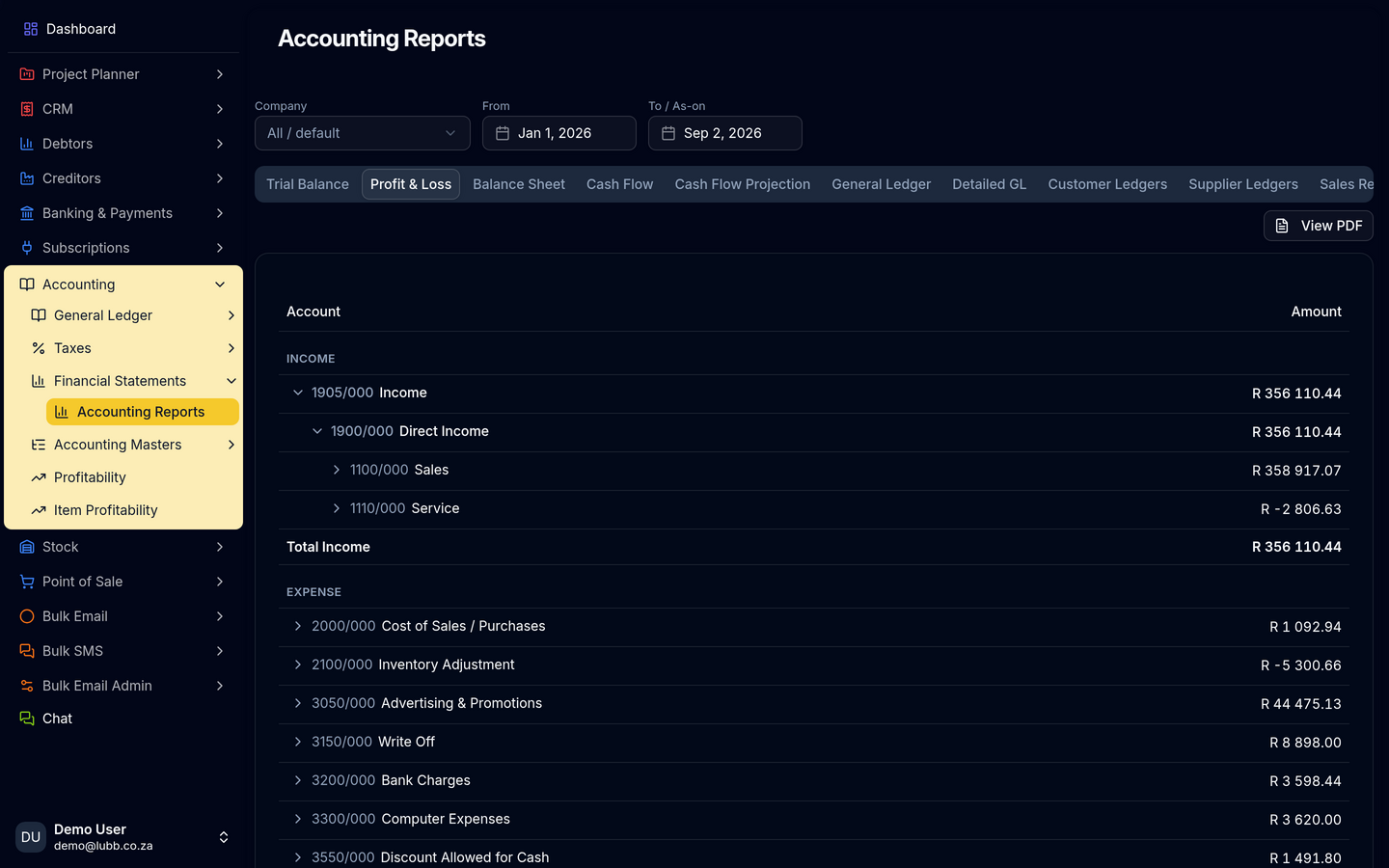
Full double-entry accounting — the general ledger and chart of accounts, sales & purchase invoicing, payments, journals, bank reconciliation and financial reports — with Debtors, Creditors, Banking & Payments and Stock inside it as dropdowns of the Accounting menu. Debtors: the AR ageing report, the promise-to-pay Commitment Calendar and customer statements. Creditors: purchase invoices, purchase orders, purchase receipts, supplier quotations and suppliers, with AP ageing. Banking & Payments: bank accounts and transactions, payment entries and terms, recon rules and auto-match aliases, OFX statement import and the card vault. Stock: warehouses, stock balances, reconciliations, the stock ledger, stock ageing and low stock. Multi-company: run as many companies as you need from one login, each with its own books, chart of accounts and base currency. Multi-currency: quote, invoice and take payment in any currency, with exchange rates converting every document back to the base currency of the company for reporting. Coming from Sage Pastel Partner, QuickBooks or Xero: export your chart of accounts, customers, suppliers, items and trial balance as CSV and bring them straight in, with a preview of exactly what each file will do before it does it, and the old transaction history too if you want it readable here.
What it does
Everything it covers
Debtors
AR / customer ageing report
Promise-to-pay Commitment Calendar
Customer statements
Creditors
Purchase invoices
Purchase orders
Purchase receipts
Supplier quotations
Suppliers
AP / supplier ageing report
Banking & Payments
Bank accounts and transactions
Payment entries and terms
Recon rules — match a bank narrative to an account automatically
Auto-match aliases — map a narrative to a customer once, forever
OFX/QFX bank statement import — one-click, deduped
Card vault for stored payment cards
Shared by every payment gateway app
Stock
Warehouses, including sub-warehouses
Stock balance per item, per warehouse
Stock reconciliations — count, adjust, post
A stock ledger of every movement
Stock ageing and warehouse value summaries
Low stock against each item’s reorder level
Key features
What you get
01Chart of accounts and general ledger
02Sales and purchase invoicing
03Payments and journals
04Bank reconciliation
05Financial reports
06Debtors, Creditors, Banking & Payments and Stock
dropdowns inside Accounting07Multiple companies, each with its own books
08Multi-currency invoicing and exchange rates
09Import from Pastel, QuickBooks or Xero